
From Entrepreneur to Investor: Managing Wealth After a Business Exit
Running a company and stewarding capital call for different instincts. Recognising that shift is often the most important step after an exit.
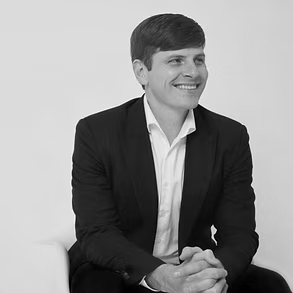
Written and reviewed by Charles Moody
Chartered Financial Planner, FPFS, MCSI

For years, the answer to almost every question was to work harder on the business. After a sale, that lever no longer exists. Capital replaces effort as the engine, and the skills that built the company are not the same as those required to look after the proceeds.
The psychological shift
Entrepreneurs are used to influencing outcomes directly. Investors cannot. Markets do not respond to effort, and there is no operational fix for a period of poor returns. Many people find the loss of control uncomfortable, and that discomfort can lead either to excessive caution or to a search for the next venture before the plan has settled.
Allowing time between completion and significant financial decisions is often sensible. Nothing is usually lost by waiting a few months.
Business risk and investment risk are different
Business risk was concentrated, informed and, to a degree, manageable. Investment risk is diversified, impersonal and expressed as fluctuation in value. Someone comfortable with the first can still find the second unsettling, precisely because it cannot be influenced. Capacity for loss should be assessed afresh, in the context of capital that now has to last.
Capital that has to last is a different asset from capital you can rebuild.
Separating capital by time horizon
A practical structure is to divide proceeds into three broad pools: short-term money for spending and near-term commitments, medium-term money for planned costs within roughly the next decade, and long-term money intended to grow. Each pool can be treated appropriately, which makes market movements easier to place in context. The value of investments can fall as well as rise, and you may get back less than you invest.
Sustainable spending
Without a salary, spending needs a framework. Cash-flow analysis helps establish a level of withdrawal that appears sustainable across a range of assumptions, and shows the effect of significant one-off costs such as property, education or family support. It is a planning tool rather than a forecast, and it should be revisited regularly.
Diversification and long-term thinking
Having previously held one large concentrated position, many people appreciate the case for spreading risk across asset classes, regions and sectors. The discipline is in staying invested through periods when the strategy feels unrewarding, and in avoiding the temptation to replace one concentration with another.
Family, philanthropy and legacy
An exit often brings family questions forward: what to share, when, and with what expectations attached. Some families choose structured conversations about the purpose of the wealth before making gifts. Others focus on charitable giving. Wills, powers of attorney and ownership arrangements should be reviewed in light of the changed position, and tax treatment depends on individual circumstances and may change in the future.
Retaining optionality
Many former owners invest again, take non-executive roles or back other founders. Ring-fencing the capital that underpins financial security first means that any further entrepreneurial activity is genuinely optional, undertaken because it is interesting rather than because it is necessary.
Giving wealth a new role
In business, wealth was fuel. Afterwards it becomes something else: security, freedom, time and, eventually, legacy. Defining that role explicitly makes the investment decisions that follow considerably easier, because there is a clear standard against which to judge them.
This article is for general information only and does not constitute personal financial advice. Advice should be based on your individual circumstances.
Discuss this in the context of your own plan
If any of this is relevant to a decision you are weighing up, a short, confidential conversation is often the most useful next step.
Arrange a conversation